November December 2026
Love and Devotion
All perfect saints have taught that the Lord is love. Love is the basis of this existence and the only effective means to unite with him …
Two Masters, One Truth: Beyond Physical Presence
In September 2024, Baba Gurinder Singh, Sant Satguru of Radha Soami Satsang Beas (RSSB), appointed Hazur Jasdeep Singh as the new Patron of all RSSB Societies and his successor as Sant Satguru …
Going Beyond
In the early hours of 7th September 1838, a dramatic rescue took place in the cold, dangerous waters of …
Truth in a Nutshell
In the beginning was the Word, and the Word was with God, and the Word was God …
What Is Swifter than the Wind?
In the ancient Indian epic the Mahabharata, the Pandavas are five brothers who lose their kingdom and endure a thirteen-year exile with Draupadi …
Go with the Flow
Mystics from diverse traditions have long looked to the natural world to explain spiritual truths …
The Potter and the Clay
The promise of a spiritual path is transformation: anyone who is initiated by a true …
Food for Thought
Is that the sound of the bell? …
A Soul’s Declaration of Love
We live in a world that constantly pulls our attention outwards. Wealth, recognition and status often become our primary goal …
Are You Drinking from Your Cup of Divine Nectar?
When you see the title of this article, you might ask yourself what divine nectar has to do with you …
Your Limitless Capacity
The inward spiritual journey requires as much from you as the world ever has …
The Final Word
Constant Remembrance …
Book Review
Free Thinkers Series: Books 1-8 …
Start scrolling the issue:
Love and Devotion
Saints have taught that the Lord is love. Love is the basis of this existence and the only effective means to unite with him. Love cannot be found anywhere outside oneself. Love for the Lord inherently exists in the soul because the soul is of the essence of the Lord. In its current state, that love is buried under thick layers of worldly attachments, sense pleasures, attraction to vices and passions, and past karmas and impressions. The real purpose of seeking the company of the saints – of devotion to the Lord or the practice of Nam – is to awaken this love within us. Love for the Lord blossoms within devotees as soon as they understand their true relationship with the Lord through the company of a saint; then they realize that their true home is the Lord’s supreme abode and their true identity is pure soul and not the mind or body.
As this love develops and grows, the lover attains a state of surrender in which he is willing to make every sacrifice for the sake of his Beloved. Tulsi Sahib says:
A lover is love, and love is the lover;
annihilation is the true sign of love.
Becoming a corpse and reducing himself to ashes,
he stands at the door to the eternal abode.
When Tulsi Sahib says that the lover annihilates himself in his love, he is referring to the annihilation of the self or ego. Tulsi is using dramatic language to describe this state: He says the lover must “become a corpse,” become dead to the world. This means that by vacating his body, he raises his consciousness to the higher realms – a state the saints call dying while living.
The real lover is one who merges his identity in his beloved. It is love alone that cultivates reverence for and faith in the beloved. A loving disciple never calculates the reward he will get from his devotion. Any love where accounts are maintained is not love but a business. A lover only knows how to give. He asks only for the Beloved from the Beloved. While telling his disciple Hriday about this quality of the lover, Tulsi Sahib says:
O Hriday! One is known as a devotee
when he adores the Master
with the surrender of a slave.
Tulsi Sahib describes his entire philosophy of love in this manner. It is the pull of love that bestows upon the soul the power to complete the long journey to its true abode. The Supreme Lord himself kindles this love within the soul. Then the soul says, “I sacrifice myself to the Beloved who loves me.” Long before reaching the abode of the beloved Lord, the soul realizes that it cannot love the Lord through its own power. It is the merciful Beloved himself who has cultivated love for the Lord within the soul, and it is only with his grace that the soul has been able to reach its blissful home, whose very essence is love.…
Devotion
Devotion is the effort made to please the person whom we love. Remembering the Beloved, thinking of him repeatedly, praising him, praying to him, serving him and obeying his instructions are all a part of devotion. Devotion arises from love. When love for the Beloved matures, it becomes the means of uniting with him.…
Without devotion, a soul cannot get liberation from the pain of living in this world, nor can it be freed from the cycle of transmigration and the agony of death. That is why saints try to strengthen our devotion. By becoming humble through service and obedience to the Satguru, our devotion will be strengthened. Yet Tulsi Sahib has compared devotion to walking on the edge of a sword because it means annihilating our ego, and this is the most difficult thing to do.…
Devotion is the essence of life,
but the worldly person does not realize this –
he considers worldly vices and passions to be real.
Tulsi Sahib explains that what stands in the way of our devotion is the misguided idea that sense pleasures and passions are real; we do not realize that they are impermanent and illusory and cannot bring us lasting happiness. Similarly, the usual types of external worship such as rituals, reading of scriptures, asceticism, and pilgrimages may turn our thoughts towards God but cannot lead to God-realization. One can only experience the Supreme Lord through the love and devotion that leads one within, to union with Shabd.
From Tulsi Sahib – Saint of Hathras
Two Masters, One Truth: Beyond Physical Presence
In September 2024, Baba Gurinder Singh, Sant Satguru of Radha Soami Satsang Beas [RSSB], appointed Hazur Jasdeep Singh as the new Patron of all RSSB Societies and his successor as Sant Satguru. This succession planning ensures the continuity of having a living spiritual guide, which is at the heart of Sant Mat philosophy.
Most seekers understand why the appointment of a new Sant Satguru is a cause for celebration. Yet, many still ask about Baba Ji’s whereabouts and hope for his presence at satsangs or question and answer sessions. These concerns arise not only at the Dera but also at many satsang centres around the world. Although it is natural to miss one’s spiritual master, this article explores other ways we can show our devotion, beyond wishing for their physical presence at satsang.
The gap between understanding, belief and our actions
Having a spiritual guide is at the core of all mystic traditions. Anyone who has tried a massive open online course [MOOC] knows how hard it can be to learn something new on one’s own. The same is true for spirituality; we need a living guide who can explain the truth about the human condition and, most importantly, teach us the method that helps our soul to connect with the Shabd. Even though a living master is essential, all mystic traditions remind us not to become attached to their physical form, because the true master is Shabd, and the soul attuned to the Shabd is the true disciple.
Many of us think we understand that the true master is Shabd, yet our actions can suggest otherwise. If we truly understood this, we might ask ourselves why we feel the absence of one master even when another is present. Perhaps our heart and soul reveal something our mind has not yet fully absorbed: given that Shabd is the true master, being with one Shabd-realized master is the same as being with another. Seen in this light, the question of who is absent seems less pressing. Instead, we might marvel that, out of billions of people on earth, we are among the fortunate few to sit in the company of a true guru.
Some of us place the Master on a pedestal and believe that, as his true form is Shabd, he is therefore one with everything. The author of Concepts and Illusions points out one way this belief can feel empty:
The most crucial and only test of our belief… is do we obey his wish for us to meditate? If we do not follow the one and only command (hukam) from the one we believe is the Master, then we are mocking our belief, we are pretentious about our belief – for who would have the gall to disobey the Master’s commandment?
These words are uncomfortable precisely because most of us will recognize ourselves in them. The author is not criticizing us but holding up a mirror. Most of us would never dream of disobeying the Master, yet our daily meditation often tells a different story.
Besides not practising meditation every day (despite his explicit wish that we should do so), there is another way our actions reveal the gap between what we say or believe and how we behave. If the Master is one with Shabd, it’s logical that everything he says and does should guide us. Here, Hazur Ji’s response to questions about Baba Ji’s absence shows us exactly what that looks like. When asked why Baba Ji is not at satsang or when he will come, Hazur Ji states that he does not have the audacity to question his Master about his whereabouts. As well as revealing his humility and deep love for Baba Ji, Hazur Ji’s answer teaches us how to let go of such questions.
The greatest act of love
It is only natural to feel a special connection to the Master who initiated us and to wish to bring him happiness. For thirty-five years, Baba Ji has reminded us that true love is expressed through our actions, not our words. Therefore, the best way we can demonstrate our love for the Master is to practise our meditation faithfully.
In fact, provided we practise consistently, the more challenging we find meditation, the deeper our love may be. Why? Simply because it is easy to meditate when we feel inspired. True devotion, however, is practising meditation when we find it difficult, when we are not in the mood, when our emotions have faded, and we feel empty. While the mind urges us to give up or postpone our practice, it is love that compels us to sit, begin again, and persist. As recounted in a Spiritual Link article in 1965, Maharaj Sawan Singh explained to Daryai Lal Kapur:
Real praise is due to him whose meditation is drudgery and a distasteful task, and still he attends to it. Lord values an hour of such meditation more than ten hours of [someone who relishes it]. This is the real service of the Master.
We may also draw comfort from recognizing that, while we may labour under the delusion that the Master only values ‘good’ meditation, he continually reminds us that what truly matters is our effort, not the perceived quality of our practice. If our body won’t stay still or aches and yet we keep trying, that’s effort. If our mind wanders and yet we return to simran, that’s effort. Even if we fall asleep and start again, that’s effort too. In fact, when Daryai Lal Kapur reported his frustration and grief over his apparent failure to focus his mind during meditation, Maharaj Sawan Singh reassured him that what we perceive as struggles or shortcomings, the Lord regards as acts of love. Writing about this encounter in his article, Daryai Lal Kapur said that the Maharaj Sawan Singh told him to read the following line from Rumi’s Masnavi:
Lord loves our failures and useless efforts. He values our unfruitful sincere attempts more than the fruitful ones. Worthless endeavour is better than sleeping.
Maharaj Sawan Singh went on to explain the quote by using an analogy of a parent watching a toddler learning to climb the stairs. The child grips the railing with both hands, hauls one small leg up and wobbles. The child will no doubt slip and may even sit down in frustration. To the parent, each attempt is not a failure but something joyous. The parent does not wait impatiently for the child to reach the top but watches every stumble with love and tenderness. Once the child can run up the stairs without thinking, the parent barely glances over.
Similarly, by embracing the previous quotes, we appreciate that until we reach the third eye, our meditation is like that child’s practice; precious to the inner master, not despite its imperfection but because of it. Every session in which we sit when we would rather not, every return to simran after the mind has wandered, every time we refuse to give up, are not shortcomings that the inner master tolerates. They are acts of love he treasures.
Yet understanding something and truly absorbing it are not always the same. Even as we recognize that our struggles are received as acts of love, many of us still carry an unspoken expectation that ‘good’ meditation should be rewarded with inner darshan, noticeable virtue, the eradication of one’s weaknesses, and a growing indifference to life’s problems. When we measure our practice against these outcomes, we may feel that such attainments lie far beyond what our efforts have yet produced. The deeper lesson, however, is that these are not the objectives of meditation, nor can they be demanded as proof that our practice is working.
Meditation is the greatest seva we can perform, and seva is fundamentally about giving, not receiving. What may please the Master most is not a particular inner experience, but a change in our attitude: from approaching meditation as a transaction in which we sit to obtain darshan, hear the Shabd or see its light – to embracing it as an offering. In meditation, we give our time, attention, persistence, and our very selves (heart, mind, and soul) to the Master. When we give in that spirit, even our difficulties become part of the love we are trying to express.
Gratitude and living in his will
Our masters emphasize that gratitude is the bedrock of spirituality. If meditation is the highest expression of our love for the Master, then expressing our gratitude by living in his will may well be our second greatest act of love. Practically, this means respecting his decisions, even when they do not align with our preferences. If the Master attends satsang, we are grateful; if he does not, we accept that as well.
It is natural to feel disappointed if one of the Masters does not attend satsang. However, when given the opportunity to ask a question, it is worth pausing to consider how best to use it. Asking about the absent Master’s whereabouts is understandable, but since he acts according to his own will, such questions are unlikely to change anything. We might instead direct our questions towards what will benefit us spiritually and, in turn, be of value to the wider sangat.
Another way in which we can demonstrate living in the Master’s will is by making Hazur Ji’s transition as Baba Ji’s successor as smooth as possible. As well as dedicating ourselves to meditation, the most meaningful support we can offer is to refrain from asking Hazur Ji questions prompted by grief at Baba Ji’s absence. Such questions, however sincerely felt, draw attention away from Hazur Ji’s own presence and, in so doing, from the ways his teaching may benefit us. Our truest support, then, lies not in our questions but in our silence and our meditation, which brings to mind the parable of the lost sheep.
Imagine a new shepherd taking over a flock. If the experienced sheep stick to safe pastures and steady paths, they make the new shepherd’s task manageable, joyful even. However, if the experienced sheep begin to wander and get lost on the hillside while looking for the old shepherd, the new shepherd faces a double task: gently guiding the new lambs while also scrambling over the hills to search for the lost, experienced sheep.
Making the pain of separation work for us
At its heart, spirituality is a path of love and devotion, on which disciples throughout the ages have felt a deep ache when separated from their master. As the author of Tulsi Sahib explains, this pain is a gift from the Lord:
Just as love is a blessing from the Lord, longing is his gift as well. In fact, love matures and ripens in separation. The pangs of separation and longing destroy worldly desires. In separation, every pore of the lover calls out to the Beloved. Separation is the ladder which takes the loving devotee to the feet of the Beloved.
This is a crucial insight. We must be careful not to let the pain of separation become something we emotionally endure without allowing it to transform us. Instead of being overpowered by the feeling of separation, why not make this longing work for us? For instance, if we feel the Master’s absence keenly, perhaps because he was not physically present at a satsang, that feeling is a call to action. Are we willing to put our feelings into action by devoting extra time to meditation that evening? That is, on top of the time we’ve already devoted to meditation in the morning?
Before doubt about our ability to do so creeps in, we must pause and remember who we truly are. Our true self is the soul, which is Shabd, and the Shabd is all-powerful. Furthermore, we must ask: who is it, really, that we think is missing whom? The notion that our physical self, our constructed identity, is pining for the Master’s physical form is an illusion of the mind. The separation we feel is experienced by our soul, yearning for the Shabd, the divine current, that is manifesting through the Master.
The extraordinary feats of selfless seva unfolding across satsang centres worldwide are proof of the Shabd in action. If our love were merely physical or emotional, such sustained selflessness would be nearly impossible. We often say, “The Master is doing everything.” But who is the Master? The Master is Shabd, and who is performing the seva? It is that same Shabd, working through each sevadar.
Even if we haven’t participated in organised seva, we’ve likely witnessed or experienced firsthand the lengths we go to for outward darshan. Regardless of age or physical ailments, we rise before dawn without hesitation, forgoing comfort and nourishment. We hurry to be at the front of the line, then wait patiently for hours, all for a glimpse of the Master’s physical form. Motivated by love, we endure this discomfort gladly.
If we can muster such determination for an outward glimpse, there is no reason why we cannot channel that same resolve into our meditation. We may not immediately experience the inner darshan we hope for, but by practising sincerely, we automatically draw closer to the Master. No matter how far our meditation session falls short of the ideal we envision, we experience peace and quiet happiness just from knowing we have offered our best effort, and in that offering, the separation itself begins to dissolve.
The longing we feel is not an obstacle on the path; it is an invitation. Every pang of separation is the inner master calling us towards the only meeting place that is always available: the stillness inside. We have been given extraordinary gifts: a living master, a proven method and, perhaps now, the gift of longing to give our practice urgency and depth. The only question worth asking is not “Where is he?” but “Am I showing up?” If we can answer that honestly in the quiet of our meditation each morning, we may find that the distance we feel is far smaller than we imagined, and that the love waiting for us on the other side of that silence may be far greater than we dared to hope.
Going Beyond
In the early hours of 7th September 1838, a dramatic rescue took place in the cold, dangerous waters off the coast of northern England. Grace Darling was the young woman who helped the stranded sailors and rowed them to safety. From her bedroom window in the lighthouse, she had noticed the danger faced by the ship’s crew and a lone passenger. After urging her father to attempt a rescue using their only seaworthy vessel – a simple rowboat – they set out at dawn. Between them, they saved nine lives, and Grace became a national heroine. Her bravery is still honoured in children’s storybooks today. Just search online for images of towering waves, worried faces, and this determined girl.
For every legendary good deed, many more go unnoticed or fail to capture the public’s imagination. However, we highlight some actions, such as those of Grace Darling, because they vividly embody cherished principles. Grace did what we all aspire to do, but in practice find so difficult. Putting others before herself – she went beyond.
Beyond what? Beyond the call of duty; beyond the norm, which for a young woman of that era, in her early twenties, would have been to be a dutiful daughter and a regular churchgoer – she would not have been expected to provide physical assistance in a rescue. Assistance meant insisting that she went out as an oarswoman, making possible her father’s part in the rescue, as well as her own. It involved physical effort and courage in the face of daunting odds. Acting in this way requires a moral compass, formed and maintained independently of what the world around us dictates. Examples of a moral compass include core values and principles such as responsibility and compassion. These are demonstrated through actions. It was this independent moral compass that enabled Grace Darling to respond without hesitation to the shipwrecked sailors’ plight; she went beyond the call of duty and is rightly celebrated for the responsibility and love that powered such an act.
Few of us encounter a disaster like the one Grace Darling faced. However, daily life presents its own challenges, and in dealing with them, we often find that ‘going beyond’ is the only way forward. Let’s consider some everyday situations.
Regarding our beliefs, we may not always find it easy when we start living the Sant Mat way of life. Some of us are born into satsangi families where the entire household might be vegetarian; parents may attend satsang, practise meditation, and support a child seeking initiation. But what if our circumstances differ? What if those we share our lives with are not vegetarians, follow a different spiritual path, or none at all? If that is the case, how will we respond? One will ‘go beyond’ by drawing on the same well of self-belief and energy as the nineteenth-century heroine facing a shipwreck. We are so designed that we instinctively know how to rise above obstacles and turn even the most conflicting situations to our advantage.
Consider, for instance, what happens when you have promised yourself that you will retire early and meditate for two hours, but your spouse wants you to spend the evening with the family. Or when you have recently adopted a vegetarian diet, but your mother interprets this as a rejection of her cooking and admits she is upset. You have already ‘gone beyond’ by choosing a different path in life from those around you. Now, you need to go further by recognizing and respecting others’ rights to be themselves while also staying true to your own goals. It will require all the goodwill and diplomacy you can muster. It might even uncover the charm you never realized you possessed as you tell your mother how much you love her cooking and look forward to her saag paneer. And by the way, your spouse will be happy that, although you are taking time for yourself tonight, you have a family outing planned for tomorrow.
Amidst all these highs and lows, we have an invisible yet constant friend by our side. This is the true Master who found us in this creation, initiated us, and will accompany us on our spiritual journey right to its conclusion. In his spiritual form, he is always close, and we should remember this as we go about our daily lives. In his physical form, the Master offers opportunities to express our difficulties through question and answer sessions, and he invariably advises us not to react to unfavourable circumstances, but to rise above them. Reacting disturbs our mind and emotions, and staying in that state is like being caught in a turbulent ocean. The negativity produced keeps us immersed in an unpleasant brine of conflict. However, if we refuse to react, we can progress like a small vessel propelled by strong oars, and go beyond.
When differences are so deeply ingrained that they resist change or compromise, then ‘going beyond’ depends on the God-given gift of acceptance. Letting go of expectations and aspirations, recognizing that events dictated by karma must simply be endured, we accept the situation as it is – good, bad, or ugly. We transcend personal judgments and instead breathe a different air, that of divine will.
To be honest, isn’t all of life an effort to do just this, and don’t we have within us that which pulls us upwards? Maharaj Charan Singh wrote in Spiritual Perspectives, Vol. I:
The purer the mind becomes, the more it is attached to the shabd and nam. The purer it becomes, the more strength and power it gets.… As I often explain, in the body the seat of the soul and the mind is here at the eye centre. The more downward the mind’s tendency, the less willpower we have. The more upward its tendency, the stronger is our willpower. So it is the spirit that actually gives you strength and willpower.
Trying our best and accepting the Lord’s will draws us closer to the inner power of Shabd, which will generate its own unique uplift. The masters sometimes use the example of a hand of cards to show how wise choices can have a significant impact. In a game, we might be dealt a strong hand or a weak hand. It was the luck of the draw, not something we could control. But regardless of the hand we hold, what truly matters is how we play with what we have.
Sant Mat is straightforward – it consists of regular meditation, supported by simran during the day, as instructed by the Master. This is combined with a promise to follow a lacto-vegetarian diet, avoid alcohol and mind-altering drugs, and lead a morally upright life. However, as many of us realize, this is easier said than done. The waves of our own karmas threaten to overwhelm us, much like the waves of that northern sea battled by Grace Darling. We can continue our journey by fixing our gaze ahead (keeping the goal of union with our loving Master in mind) and by following good navigational rules to steer safely through the rocky waters.
Spiritually speaking, the rules of good navigation are the four principles that aim to manage our human fragility so we can reach our ultimate goal. Additionally, we are social beings and ‘doers,’ happiest when active, so the Master recommends we use our free time in seva. The days are gone when a master’s group of disciples was so small that service was directly to that master. But we can view any tasks supporting his satsang centres and sangat as important as serving the Master himself. When service is done conscientiously, lovingly, and in accordance with the guidelines set by those appointed to oversee the work, he is present with us. We are strengthening that vital connection with our Master, which naturally leads us to turn to meditation to enjoy his presence even more.
Another human trait is our tendency to be influenced by our surroundings, which sometimes causes us to lose sight of our good intentions. Therefore, the Master recommends regular attendance at satsang, where we are reminded of the teachings and can connect with like-minded individuals. He advocates that we strive to be good human beings, demonstrating kindness and compassion through practical actions. These navigational tactics – ways to respond to life’s challenges – help us stay more focused on our Master and better prepared to sit for those two and a half hours in meditation. The self-discipline we show by consistently engaging in seva and attending satsang sends a clear message and response: “You can do it!” and “Yes, I can!”
Beyond this world’s rocky shore, the small boat carrying us (our faith, effort, practice, and above all, our Master’s grace) will set out, overcoming the waves to steer a steady course until we overcome the hazards, reach the shore, and are received on safe ground.
Truth in a Nutshell
In the beginning was the Word, and the Word was with God, and the Word was God. The same was in the beginning with God. All things were made by him; and without him was not anything made that was made.
Gospel of Saint John 1:1
***
The beginning and end of all things is Shabd. All gross matter, the sky and so forth, subtle matter, sound, form, taste and scent are all Shabd. Whatever exists is Shabd. Whatever is manifested from Shabd cannot be anything but Shabd. Shabd is our creator. Shabd is our sustainer. We are of Shabd and Shabd is ours. The Gurus say that Shabd is the Supreme Lord.
Maharaj Sawan Singh, Philosophy of the Masters, Vol. IV
***
There is but one God;
true is his Name.
He is the Creator,
without fear,
without enmity
and of timeless form.
Unborn and self-existent,
he is realized through the Guru’s grace.
Jap Ji: An Introduction
What Is Swifter than the Wind?
In the ancient Indian epic the Mahabharata, the Pandavas are five brothers who lose their kingdom and endure a thirteen-year exile with Draupadi, their shared wife. During this exile, the eldest brother, Yudhishthira, approaches a lake and is about to drink when he hears the commanding voice of Yaksha, the lake’s self-proclaimed owner: “You may not drink until you answer the questions I wish to put to you.” A rapid exchange of riddles follows, with Yaksha posing questions and Yudhishthira responding swiftly.
Yaksha’s riddles are not a test of knowledge but serve as a measure of self-realization. They probe whether Yudhishthira understands the moral and cosmic order of reality and, more importantly, whether he lives in harmony with it. His answers come quickly, not because he is recalling learned facts, but because his mind is already attuned to truth. What, then, can we as seekers learn from these ancient questions?
One of the questions put to Yudhishthira is, “What is swifter than the wind?” He answers, “The mind.” His answer is immediately recognizable to us. The mind can be focused on a task at hand, yet race through an old insult, a worry about the future, a desire that refuses to loosen its grip, or a fear that steals sleep. Even when everything is going well and we have nothing to worry about, the mind’s constant chatter prevents us from experiencing inner peace. It judges, compares, replays, plans, and argues. We have conditioned the mind to focus outward since the beginning of time. As a result, to turn our attention inward feels unfamiliar and unnatural.
A mind that is constantly racing outward is also a mind that is always craving more. Perhaps this is why, later in the exchange, Yaksha asks about the barrier to happiness, and Yudhishthira’s answer is “Greed.” A different way of asking the same question would be, “What is true happiness?” We might reply, “Contentment.” But this is where many of us stumble. We associate happiness not with what we have but with what is lacking. We satisfy a desire and experience an uplift, but soon that joy or satisfaction becomes ordinary. Then the mind moves the goalposts: a little more, something else, just one change, and we will be content. When comparison takes hold, what was once enough becomes insufficient, and dissatisfaction sets in.
If contentment is the heart of happiness, then why is it so rare? Because the mind is restless by habit, quick to remember every grievance and desire, yet quick to forget what truly matters. That is why Yaksha’s final question strikes like a bell: “What is the greatest wonder in the world?” Yudhishthira answers that each day, people die, yet the rest of us carry on as if we are immortal. The question is not meant to make us gloomy, but to awaken us to the reality of our mortality. When mortality is forgotten, life becomes a race of small achievements and endless demands. When mortality is remembered, priorities rearrange themselves.
The restless mind and its consequences, however, do not operate in a vacuum. They are governed by a deeper structure: karma. Saints teach that the world is governed by karmic law. Actions, shaped by intention, leave imprints. The body dies, but the karmic account does not simply vanish. The soul carries unfinished burdens: the residue of past actions and unfulfilled desires that pull it once more into another form. Even good deeds do not free us from the karmic chain; good actions are just as binding as negative ones. Our problem is that we cannot escape the consequences of our choices. We may desire the freedom to act as we please, but what we need is freedom from bondage itself.
This is why the saints keep reminding us of the rarity of human life. We could have been born into any form, yet we have been granted the human form, and with it, the capacity to know ourselves and to turn our attention inward consciously. Health, family, and work all matter, but they are not the primary purpose of life. The primary purpose is for the soul to return to its source.
In moments of introspection, the mind itself recognizes that its restlessness and constant craving have bound it ever more tightly in the web of karma, even as this rare human birth offers the opportunity to break free. The mind resolves to change, but it cannot do so through sheer willpower alone. An entity that is the source of restlessness cannot create lasting stillness simply by making promises to itself. This is why saints have always stressed the need for a guide. Just as no difficult skill is mastered without a teacher, a restless mind cannot be conquered by reading, affirmations, or drawing on someone else’s experience. A true, living master is needed; one who can guide the soul safely through the mind’s subtle traps. The mind is clever; it can imitate spirituality, mistake imagination for experience, and inflate a little knowledge into ego. A living master protects us from these deceptions and keeps us grounded.
The living Master is not a magician sent to fulfil worldly wishes. His purpose is far more important: to provide a practical method by which the soul can reconnect with Shabd – the divine inner sound – and, through that connection, gradually free itself from the mind’s control. The method is given at initiation, and from this point forward, our aim is to gather our scattered attention and turn it inward. To do so, we begin by repeating simran, the five holy names given during initiation. The mind is already accustomed to repeating things to itself: desires, worries, arguments. Simran works with this habit rather than against it: instead of silencing repetition, it redirects it to the power of the Master’s names.
At first, it seems impossible to complete even a single round without the mind running away. Yet bringing it back, again and again, is itself the practice. As the mind begins to settle, however briefly, we turn to the second part of meditation: listening for the Shabd, the divine melody that is already present within us. Shabd is not a tune we can create or manufacture. It reveals itself only in stillness, and it is simran that prepares the ground for that stillness. As the soul connects with Shabd, it is Shabd that cleanses it of its impurities and burns away its debt of karma.
The message of the mystics is clear: time is limited, the mind is restless, and this opportunity is rare. With sincerity and patience, we keep turning to the Master’s teachings and the Shabd he has awakened within us. The mind may run swifter than the wind, but the Shabd is mightier still, and the Master’s guiding hand is always leading the disciple in the right direction.
Go with the Flow
Mystics from diverse traditions have long looked to the natural world to explain spiritual truths. One of the most enduring metaphors is water. The phrase ‘living waters,’ for example, is found in texts dating back several millennia and describes God’s creative power, the Word, in spiritual traditions from the Middle East to South Asia. Water as a metaphor also helps us understand other aspects of spirituality. This article explores what water can teach us about the mind, our receptivity to grace, and what it means to go with the flow of life.
Water is both powerful and beautiful. It gives life and shapes the world around us. When water is clean and pure, it looks clear and bright. For example, water flowing from a mountain is so transparent that you can see every stone and pebble on the riverbed. But when storms strike and the wind picks up, the riverbed turns muddy, fills with debris, and the light that once reached the bottom can no longer get through. However, if left undisturbed, the mud and debris slowly settle, and the water becomes clear once more.
Our minds work in much the same way. When we are caught up in wants, worries or anger, we lose our inner balance, and the Lord’s grace can feel distant. It is not that grace is absent, but that we are too unsettled to notice it. The mountain spring teaches us that the mud does not need to be forced out; it settles on its own when the water is still. In the same way, we do not find clarity by struggling or fighting our thoughts. Clarity comes naturally when we sit quietly and let go of our worries. When our minds are calm, God’s light can shine through.
An innate desire exists within humans to connect with God. We might ignore or suppress this feeling, but it can resurface. An example of this is when we hold a newborn – something within us recognizes and longs for that original closeness to the divine. Even so, a new baby comes with its own destiny, and we know that such purity and innocence are short-lived.
As we grow older, the world fills our minds with noise, making our innate longing harder to hear. Today, with the internet and AI, information reaches us instantly from all directions, and if we are not careful, this constant flow can clutter the mind rather than enrich it.
Moreover, these technologies can gradually condition us to seek constant stimulation, drawing our attention compulsively from one screen to the next. Little by little, we drift away from our natural inner stillness.
Nonetheless, the wisdom of going with the current of life, rather than against it, is so timeless and universal that even a simple children’s nursery rhyme captures it:
Row, row, row your boat
gently down the stream,
Merrily, merrily, merrily, merrily,
Life is but a dream.
The nursery rhyme encourages us to go through life quietly, not to fight its natural flow of ups and downs, and to adopt a positive outlook. But how do we return to that gentle flow in our lives? How can we clear and calm the mind? Saints from many traditions say that meditation, as taught by a true living master, is one of the surest methods. By focusing our attention at the eye centre, meditation helps the mind become lighter, clearer, and more focused within. Over time, we can become aware of God’s presence within. This is the path of Surat Shabd Yoga. In Light on Sant Mat, Maharaj Charan Singh writes, “The best way to cleanse the mind is to vacate the nine doors of the body through repetition of the five holy names, repeated with love and devotion.”
In this sense, meditation is like spiritual water. Just as water cleans and refreshes everything it touches; meditation cleanses the mind and restores its natural clarity. As this happens, spiritual calm begins to flow into our lives, and we start to feel the Lord’s presence and grace shining quietly within us. As the English proverb says, “Still waters run deep.”
Water also teaches us something important about surrender and living in God’s will. Water is completely flexible. It takes the shape of whatever holds it and never insists on its own form. When a stream meets a boulder, it does not fight or stop; it simply finds another way forward. Can we face life’s obstacles with the same quiet wisdom? Just as every stream is meant to reach the sea, our souls are drawn to their true home, the divine spiritual vibration of God – the Shabd.
In Spiritual Perspectives, Vol. III, Maharaj Charan Singh states: “If you swim against the waves, you will drown, but if you swim along with the waves, you will go easily to the shore.” As our time and energy are limited, we are encouraged to focus on the purpose of life: self-realization and God-realization. Meditation makes this possible by clearing the mind, steadying the heart, and helping us move with the current instead of against it. Thus, the nursery rhyme takes on new meaning for us. We are reminded to row gently, move happily, and remember that this life, with all its joys and challenges, is just a dream. We are truly fortunate to take the journey of life with the love of our Master shining within us, lighting our way.
So, shouldn’t we be the merriest of all?
The Potter and the Clay
The promise of a spiritual path is transformation: anyone who is initiated by a true, living master can be lifted to a level of fulfilment. Transformation can be viewed from various perspectives, but this article concentrates on divine will. In Sikhism, divine will is called hukam, although other traditions refer to it with different names. Regardless of the term used, the common thread is that the cosmos functions according to divine will, and one’s spiritual journey involves recognizing, accepting, and ultimately surrendering to it.
What is hukam?
The Lord’s hukam, as explored in Jap Ji: A Perspective, has many dimensions. The first is conveyed in the first stanza of the Jap Ji, where Guru Nanak uses the phrase “the command of the Lord with a will,” indicating that the Lord is not an unconscious power but a supreme consciousness with will. The significance of this becomes clearer when we contrast the Lord’s will with an unconscious force, such as electricity. Electricity is powerful, but it has no consciousness; it cannot choose where to flow or why. The Lord, by contrast, has supreme knowledge and is the commander of choice. He chooses according to his will and applies knowledge to fulfil his will. As the medieval saint Namdev puts it, “All rests on the Lord’s will, and he is himself the operator of his will.” In other words, every person, creature, and even every blade of grass moves within the current of hukam. Nothing falls outside it.
Alongside the Lord’s conscious intention, Guru Nanak explains that hukam also refers to the laws through which that intention expresses itself in creation. In the third stanza of the Jap Ji, Guru Nanak states: “By his command, the Commander sets the universe on its course.” Here, hukam refers to the physical, moral, and spiritual laws governing creation, which are not random but deliberately established. In the moral realm, it is the Lord’s will that our actions are governed by the karmic law of cause and effect: as we sow, so shall we reap.
Accordingly, hukam sets our karmic destiny into motion, and we have no choice but to experience it. This can seem cold, impersonal, even unforgiving, and it may create a sense of helplessness. Yet mystics teach that the Lord’s will is saturated with his compassion. Whatever he does is for the well-being of the individual soul. This means that to live in hukam is to accept both joy and grief as equally flowing from the Lord’s hand. Mystics say that we are only half obedient if we happily attribute our blessings to God’s grace but refuse to accept our sorrows as equally his will. To acknowledge both in the same spirit is to accept hukam fully. This is what Christians mean when they pray, ‘Thy will be done’.
However, learning that the cosmos operates according to hukam does not, by itself, lead to spiritual transformation. Simply understanding that our lives unfold under the Lord’s karmic law does not make it easier to accept what that law brings us. In fact, the very act of categorising events as ‘good’ or ‘bad’ indicates that we have yet to truly live in hukam. To enable us to go beyond understanding and to live in hukam, a true, living master is essential.
How to live in hukam
When a disciple is initiated, the Master places his Radiant Form within the disciple and guides their transformation at every stage. The Master is like a potter at the wheel, supporting the clay with one hand inside the vessel while shaping it with the other from the outside. Everything happens for a reason; each experience becomes a tool the Master uses to diminish the ego – that gives rise to the illusion of separation between the soul (the true disciple) and the Radiant Form of the Master.
The disciple’s role is to cooperate with this shaping by surrendering to the Master. In Spiritual Perspectives, Vol. III, Maharaj Charan Singh explains what this means: “Surrender is when we take our ego and I-ness out of us. As long as the mind dominates the soul, there can be no surrender.” Elaborating on this, Maharaj Charan Singh clarifies that our soul, which is the essence of the Lord, is currently dominated by the mind, which in turn is controlled by the senses. This means: “The senses are the master of the mind, and the mind is the master of the soul. Unless the whole process is reversed, what can we surrender?”
This is the heart of the matter. True surrender, which the masters call sharan, depends on the soul gradually reclaiming authority over the mind and, in time, beholding the Radiant Form of the Master within. Maharaj Charan Singh explains how we may evolve to this state:
To attain that real surrender, which we call sharan, we have to remain within the dictates and principles that were told to us at the time of initiation. We have to put forth our honest efforts to remain on the path, to give time to meditation. That, in a way, is surrender to the master, and this surrender will lead to the internal surrender, the real or unconditional surrender.
So, gradually the soul begins to reclaim authority over the mind and, in time, through the method of contemplation, as instructed at initiation, comes to behold the Radiant Form of the Master within. In the Dawn of Light, Maharaj Sawan Singh tells us:
When we succeed in this method of contemplation, the radiant form of the Master appears within and becomes our guide in the upper regions of the spiritual journey. Thereafter he takes full responsibility to lead us to our goal and gives us constant guidance at every step. That form subsequently merges in Shabd, its real form.
True surrender does not begin with a grand declaration of renunciation, but with faithful adherence to Sant Mat’s four principles: eating a lacto-vegetarian diet, abstaining from all intoxicants, striving to become a good human being, and meditating for two-and-a-half hours each day. Of these four, meditation is the engine that drives all the rest, for it alone has the power to turn the mind away from sensual pleasures and cultivate an attitude of genuine acceptance. Yet to truly live in hukam, the outward discipline of following Sant Mat’s four principles must be supported by a sincere willingness to cultivate an inner attitude of acceptance. This involves a willingness to see whatever our destiny holds as coming from the Shabd Master, whether it tastes sweet or bitter.
When we resist our destiny, we are going against the Lord’s will. When we accept it with gratitude, we are moving in accordance with it. On the nature of this acceptance, Maharaj Charan Singh uses the analogy of human love, observing, “We always try to do what pleases the other person, and never try to assert ourselves or to adjust the other person to us. We always adjust ourselves to the other person’s will.… Spiritual love is the same.” Nonetheless, this attitude of acceptance cannot be manufactured through effort alone. It stems from deep love for the Master, and that love can only be cultivated through meditation.
The more sincerely we dedicate ourselves to meditation, the closer we move toward true inner surrender. In fact, mystics see meditation not just as a preparation for surrender but as an act of surrender itself. Maharaj Charan Singh states, “Whatever time we are giving to meditation, we are putting in effort to surrender. We are trying to surrender to the Father, and that is the only real surrender.”
Over time, something begins to change. Our daily practice makes us more receptive to the Lord’s grace. Greater receptivity helps us begin to let go of our ego, and we find ourselves more accepting of the events in our lives. We do not judge them as ‘good’ or ‘bad’ nor do we react to them.
Upon reaching this stage of acceptance, we come to the deepest realization of all: there is no other doer but the Lord. Once we awaken to this truth, recognizing that we are not the doers but instruments of Shabd, then there is no ego to claim the fruit of any action. When we attain this state, our actions become nishkam – selfless and desireless – and therefore free from new karma. Yet, this very realization contains a final paradox: from the absolute perspective, we can neither walk this path by our own free will nor accept the Lord’s will through our own effort. Even our surrender is possible only through his grace.
Maharaj Charan Singh describes unconditional surrender as “when we see the master inside, forget our self and merge in his will, in his love. We will feel that we are the master there – ‘we’ do not exist”
We are the clay on the divine potter’s wheel. We are being kneaded and softened in the hands of the master potter, who is transforming us from a lump of clay into a beautifully shaped vessel. That vessel is empty, hollowed of the false self. Yet an empty vessel is not truly empty; it holds space. Comparing the soul to space enclosed within a pot, the Mandakya Upanishad observes that the space only seems to be contained; in reality, it is one with the infinity of space around it. So when the master potter hollows out the vessel, what is uncovered was never truly confined in the first place.
The soul is not transformed. Unconfined, it is one with the Shabd.
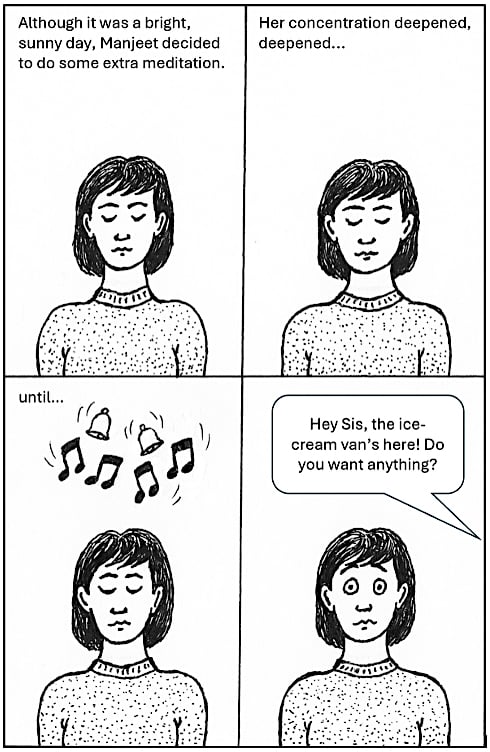
Food for Thought
Is that the sound of the bell?
A Soul’s Declaration of Love
We live in a world that constantly pulls our attention outwards. Wealth, recognition and status often become our primary goals. We spend our days working hard at our jobs and caring for our loved ones. Over time, it’s easy to believe that this is all life has to offer, but is it?
From the moment we are born, we belong to someone: a mother, a father, a friend, or a teacher. These relationships are important; they give our lives meaning and form the foundation of who we are. Yet, we rarely pause to ask: what happens when they end? All relationships are temporary, even the closest ones. So, when those we rely on leave or let us down, where do we turn?
Mystics teach us that there is one relationship that lasts forever: that between the soul and the Lord. Unlike our worldly ties, this connection is not based on need, expectation, or circumstance. It is rooted in love and endures even when everything else fades away. The fifth Sikh Guru, Guru Arjan Dev, expressed this truth in the following verse:
You are my father, you are my mother,
you are my friend and you are my brother.
With you as my protector in all places,
what fears and worries can I have?…
you are my shelter, you are my honour.
Voice of the Heart
More than a poetic sentiment, these words are a declaration of love and surrender from the soul to the divine. For the mystics, the divine is not a distant, unknowable force, but the eternal truth that resides within every living being. “Closer is He than breathing and nearer than hands and feet,” wrote the nineteenth-century English poet Lord Tennyson. Yet if the divine is so close, why do we not feel it? The mystics tell us that although the soul originates from a higher realm – Sach Khand – it becomes entangled in the distractions of creation and forgets its divine source.
Guru Arjan Dev’s verse is a heartfelt call from the soul, recalling where it truly belongs and reaching out to its eternal origin. It is a declaration made not out of despair, but out of spiritual insight. When the soul turns inward and recognizes that nothing in the world is truly permanent – not relationships, status, achievements, or possessions – it begins to see the divine as its only true companion and eternal parent. Such an understanding reflects a profound shift in perspective: everything we search for outwardly – love, support, guidance, knowledge, security – already exists within us, in its purest and most lasting form.
The realization that we have been searching the world over for something that was always within us arises through the practice of meditation taught by a true, living master. Just as a traveller lost in unfamiliar terrain needs a guide who knows the way, the soul needs someone who has already made the inner journey and can explain the path home. This is the role of the Master.
At the time of initiation, the Master imparts the meditation practice, which will enable the soul to realize that lasting happiness is not to be found in the creation but in attaching itself to the eternal sound current – Shabd. This is not an intellectual understanding but a living, heartfelt experience. By attuning to the Shabd, the soul awakens to the love and care of the divine, and begins to taste the lasting happiness it had long sought in the world outside.
By faithfully following the Master’s teachings, the disciple is led from darkness to light, from illusion to truth. While the world offers temporary relationships and transient comforts, the Master offers the soul a way back to its true home. Like a candle shielded from the wind by glass, the soul, sheltered by meditation and the Master’s grace, no longer flickers in the storms of life but burns steadily, clearly, and without fear.
When the soul begins to see the divine behind all forms, gratitude deepens, and fear and doubt start to fade. Every relationship becomes sacred because it points back to the one who is the source of everything. As the soul’s awareness of the divine grows, Guru Arjan Dev’s verse serves as an anchor through the storms of life. Pain, loss, and change are inevitable parts of the human experience. Yet, they lose their power to overwhelm when the soul is rooted in the living reality of Lord Tennyson’s question: “With you as my protector in all places, what fears and worries can I have?”
The Master often reminds us that the Lord’s grace is always present. Through meditation, that grace becomes perceptible. Trust deepens not only through reasoning but also through direct, inner experience. When meditation becomes the foundation of the soul, we begin to recognize divine will in both joy and sorrow, and we navigate life with steadiness and calmness. Faith, once merely an idea, transforms into something felt and known, born not from belief but from the soul’s own encounter with the divine within.
Are You Drinking from Your Cup of Divine Nectar?
When you see the title of this article, you might ask yourself what divine nectar has to do with you. The phrase might remind you of ancient Greek stories, in which nectar was a magical drink that granted immortality to those who tasted it. But is divine nectar just a myth, or were those writers pointing to a deeper spiritual truth? If it is real, what is it? What happens if someone experiences it? Most importantly, could it already be available to you?
Mystics say that divine nectar is not a drink you can pour into a glass. Rather, it is the Lord’s creative power, known by various names such as Shabd, Nam, or Logos. This power is the force that created everything and sustains it. When someone connects with it through meditation, the experience is so profound that ancient writers compared it to tasting an elixir of immortality. But this idea is more than just a myth or a metaphor. Mystics explain that when the soul connects with Shabd, Shabd removes the ego, fills the soul with divine love, and ultimately frees it from the cycle of birth and death, thereby granting it immortality. Quoted in A Treasury of Mystic Terms, Vol. III, the third Sikh Guru, Guru Amar Das writes:
Ambrosia (Amrit) is the true Name (Nām),
but one can say not its praise.
No sooner does the man drink the Name Nectar
than he becomes acceptable,
and gets absorbed in the perfect Lord (Shabd, Word).
If Shabd is the divine nectar, then what serves as the cup? The saints explain that it is the chamber of the spiritual heart. Only as humans can our souls receive the grace to find this nectar and journey inward to our divine source. To drink from this cup, we need to recognize the extraordinary gift of human life, and to use it for the spiritual purpose for which it was granted: to clean the cup so it can be filled.
To understand why the human body is such a rare and precious vessel, we need only look around us. The natural world teems with a diversity of life that most of us, unless we study it professionally, scarcely notice. According to mystics, there are 8,400,000 different species on Earth, and since that number refers to categories rather than individual creatures and plants, the total number of living things is beyond calculation. Even the count of species is difficult to determine, as a single one can encompass many subspecies. Ants, for example, belong to the family Formicidae, which alone includes thousands of species.
Mystics teach that the Lord’s creative power, Shabd, exists in everything; not a single particle of creation is without it. This means that all living things, from the tiniest organism to the largest animal, possess a soul. However, among these countless forms of life, only the soul in a human body can consciously connect with Shabd and break free from the cycle of death and rebirth. Therefore, human birth is not only rare, but also spiritually unique. Mystics further teach that every soul must pass through all 8,400,000 species before gaining the opportunity to be born as a human. Seen in this light, human life is not just a biological event but a spiritual milestone of almost incomprehensible significance. In Spiritual Gems, Maharaj Sawan Singh states:
The only difference between man and lower creation is that man’s life here was meant for seeing the Lord and reaching the highest spiritual plane, in this life. Every minute of it is worth millions of dollars.
Mystics tell us that being human is a blessing when we use it to connect with the Lord, for it is only then we may drink from the cup of divine nectar. However, we waste minute after minute outwardly absorbed in the world’s distractions. Only when our focus is fully absorbed inwardly can our cup be filled. Until then, we miss out on its sweetness.
Quoted in A Treasury of Mystic Terms, Vol. III, the fifth Sikh Guru, Guru Arjan Dev urges us:
The Nectar (Amrit) is the treasure of God’s Name (Nām).
meet together and quaff it, O my brethren.
By remembering whom peace (sukh) is obtained,
and all the thirst is slaked.
Guru Arjan Dev teaches that the nectar we seek is not distant or outside our reach. It is already within us, but to experience it, we must adhere to four lifelong principles. First, we eat a lacto-vegetarian diet, avoiding meat, fowl, fish and eggs. Second, we do not consume alcohol or take recreational drugs, as a calm and clear mind is essential for spiritual growth. Third, we strive to live morally, being honest and kind to others. These principles help us to discipline our thoughts and actions and form an essential foundation for the fourth: meditation. Practised daily under the guidance of a true living master, meditation purifies the mind. Following all these principles throughout our lives will steadily open our awareness to the Lord’s nectar that has always been within us.
Yet even with the path laid before us, saints warn that knowing the way is not the same as walking it. Quoted in A Treasury of Mystic Terms, Vol. III, the mystic poet Bhīkhā offers a sobering reminder of what is at stake:
The unstruck Sound (anhad Nād)
is resounding in the sky (gagan),
while your life is rapidly ebbing away.
Spending your time doing this and that,
you remain in illusion, and never wake up.
Is divine nectar just a myth? The saints say it is real. It is Shabd, the Lord’s creative power, and it flows in everyone. We fail to recognize it because we stay caught up in the world’s illusions – so our inner vision remains murky. We can reach it only through the meditation practice as taught by a living master at initiation. Quoted in A Treasury of Mystic Terms, Vol. III, Sant Dādū reminds us:
Those who took the poison, died;
Those who drank the Draught of Immortality (Amrit)
became immortal.
The cup is the chamber of our spiritual heart, located at tisra til, the eye centre. The nectar is already flowing within us, and the Master has shown us the way to receive it. It is up to us to do our practice – to purify our hearts through the principles he has given us – so that, with his grace, our cup may at last be filled with that divine nectar and our thirst satiated forever.
Your Limitless Capacity
The inward spiritual journey requires as much from you as the world ever has. Exploring your potential can bring resistance and stress. Yet, as you go deeper, you realize that you are more than you think you are. This journey is not easy, precisely because it is unlike anything you have undertaken before. Someone else’s experience may inspire you, but you won’t know how it feels until you venture within and discover your own capacity.
We know so much about the world, but do we truly know ourselves? We accept that we must eat, sleep, and earn money to survive. We carry out these actions automatically, never questioning whether there is more to life. Even when we decide to go beyond our daily routines, our attention stays on material things; we aim to be the first at something or the best, to earn or own the most. Then there’s the socializing and the desire to experience the world. But what is all of this for? Life’s only certainty is death, and with it, the loss of everything we have gathered. We have all heard the aphorism: “Nothing will go with you,” but who is the ‘you,’ and where will you go?
These questions turn our focus inward. In a poem rendered by the poet Coleman Barks, Rumi states: “Don’t be satisfied with the stories, how things have gone with others. Unfold your own myth.” Saints from past and present have repeatedly reminded us that our true self is a soul experiencing a human life. This can be hard to accept because, throughout our lives, we tend to believe that the body and the mind are all that is real. But what about this thing we call a ‘soul’ which is said to be part of the one and only source from which everything in existence originates?
Mystics have not only asked this question but have also answered it through direct experience. They have shone a light on a possibility we couldn’t even imagine in our wildest dreams: to realize oneself and, in doing so, to realize God. In Science of the Soul, Maharaj Jagat Singh writes:
The microcosm contains the macrocosm, and the Creator has seated Himself within the human body. You can have a full and clear view of the macrocosm and all that it contains by gaining access into the human body, at the eye centre.
If such a breathtaking possibility exists within us, why isn’t it easier to reach? Because just as we make an effort to survive in this world, we must also make an effort to turn within. Nothing of real value – least of all self-realization – comes without sustained commitment.
And this brings us to the heart of the matter: the inner commitment. Just as we devote years of energy to succeeding in this world, we must bring that same dedication to the journey within. The difference is that here, the effort benefits our soul eternally rather than being drained by something we will eventually lose. Consider this: on average, we spend fifteen to twenty years in education and another ten to fifteen years before a modicum of maturity sets in. Even after all this time, few of us would claim to understand life fully. All we have done is build a foundation from which to continue learning. Why then, would we expect the inward journey to be any shorter? Self-realization demands the same investment: time, commitment, patience, and trust in the process.
At the time of initiation, we promised to undertake two-and-a-half hours of meditation each day for the rest of our lives. This may seem a more daunting commitment now than it did then. We don’t always recognize our own potential, but the Master does. He can see what we cannot – that our capacity is limitless.
The Final Word
Constant Remembrance
Ceaselessly repeat the Name of God
and you’ll find fulfilment.
Every day, and regularly –
early morning, afternoon and evening –
keep repeating the Name.
Through times of happiness or hardship,
times auspicious or inauspicious,
resting and sleeping, keep repeating the Name.
Walking, talking, eating, working,
enjoying the pleasures of life,
never forget the Name.
Rich or poor – whatever your destiny –
stay in the atmosphere of the Name.
In childhood and youth, in dark days and old age,
in all stages of life – and at the end –
keep repeating the Name.
Great merit goes to those
who live in constant meditation.
The Name destroys mountains of misdeeds,
and it’s open to everyone – it knows no
high or low, intelligent or dull.
All can cross the ocean of existence
with the help of the Name, says Ramdas.
Many Voices, One Song
Book Review
Free Thinkers Series: Books 1-8
PUBLISHER: DELHI: RADHA SOAMI SATSANG BEAS, 2026
Dera Publications has launched a new book series on influential philosophers called the “Free Thinkers Series.” Designed for those interested in spirituality, the series offers a variety of ideas and approaches to the search for God. The hope is that these fresh perspectives will deepen our understanding of the mysteries of God and humanity.
The word philosophy comes from two Greek words: philia, meaning friendship or love, and sophia, meaning wisdom. A philosopher, then, is someone who loves wisdom. Throughout history, philosophers have sought to understand fundamental truths about themselves, the world around them, their place in it, and their relationships with others by relying on reason and logic rather than faith, emotion, or tradition. Yet their search often leads to the very heart of spiritual inquiry, making these thinkers valuable companions on any seeker’s journey.
Spanning from ancient Greece and Rome to modern times, the series covers sixteen philosophers. Each book explores the philosopher’s life, the political and cultural influences that shaped them, an analysis of their writings (or those of their students) and a summary of their legacy.
This review examines the first eight books in the series.
Socrates
By Donka Markus and Beverly Chapman. ISBN: 978-81-995784-0-1
Socrates (469 – 399 BCE), is often called the “father of Western philosophy” because he laid the groundwork for subsequent Western philosophers. Much of his lasting impact stems from his martyrdom in 399 BCE – a death he faced calmly and even joyfully, discussing the immortality of the soul with his disciples to the very end.
At the centre of Socrates’ philosophy was the ancient call to “Know thyself,” which he made the guiding principle of his life. He believed that anyone could improve both their understanding and their behaviour, provided they were willing to set aside limiting assumptions and humbly admit how little they truly knew.
This pursuit of self-knowledge was closely tied to what Socrates called the “care of the soul.” For him, this meant shifting one’s priorities away from material things and toward keeping the soul healthy and good – a task that required both self-awareness and an open heart. To this end, he sought truth through conversation, examining different viewpoints and using a method of thesis, antithesis, and synthesis to challenge and correct false beliefs.
Plato
By Beverly Chapman. ISBN: 978-81-995784-9-4
Plato (424 – 347 BCE), studied under Socrates and became renowned for explaining Socrates’ ideas more clearly than others. He was mainly interested in what it means to be a good human being and promoted a way of life focused on clear thinking and strong character.
Plato conveyed his ideas through stories in which Socrates engages in dialogue with others, illustrating that philosophy is about ongoing discussion rather than the pursuit of absolute conclusions. In these conversations, Socrates asks questions about the true nature of virtue, friendship, and knowledge, and participates as an equal. He does not claim to know the answers but works with others to learn more. In doing so, Plato not only shows that the pursuit of wisdom reflects a universal human need to understand, but also that it is accessible to everyone and does not require specialist knowledge, technical language, or skill. Through dialogue, participants are encouraged to recognize their false assumptions and gradually gain deeper self-knowledge.
Aristotle
By Beverly Chapman. ISBN: 978-81-995784-4-9
Aristotle (384 – 322 BCE), is often considered the ancient philosopher with the greatest influence on Western thought. He divided knowledge into three types: productive, practical, and contemplative, and made major contributions to both science and philosophy. He wrote over 150 works on parchment scrolls, covering subjects like ethics, politics, physics, economics, logic, metaphysics, aesthetics, and biology. He is known for creating formal logic and for his detailed studies of nature, especially in biology and zoology. Most of his writings have been lost, but the ones that remain demonstrate his lasting influence on philosophy.
Aristotle says the world is always moving toward its purpose of goodness. He believes people can use reason to understand deeper truths about the world and the divine. He argues that there must be a first cause behind all motion and change in the universe. He calls this the “Prime Mover,” the eternal and original source of everything that exists and moves.
The Cynics: Diogenes of Sinope and Crates of Thebes
By Barbara Merritt and Linda Moodie. ISBN: 978-81-686968-2-2
The first Cynic, Diogenes of Sinope (412 – 323 BCE), was inspired by Antisthenes, a follower of Socrates. His successor was Crates of Thebes (365 – 285 BCE), whose wife Hipparchia was also a well-known Cynic. The Cynics were not “cynical” in the way we use the word today. Instead, the Cynics of ancient Greece and Rome were idealists who wanted to live according to their vision of a better life. They searched for a truth they could put into practice. Diogenes is famous for walking through the marketplace in ancient Athens with a lantern, saying he was looking for an honest man.
The Cynics were not interested in abstract ideas or speculation. They cared only about how people acted. For them, living a virtuous life was most important, but not by following social rules or fitting in. Instead, they aimed to live in harmony with nature and to be open and honest in everything they did. To make their point, they rejected things society considered necessary, such as having a home, using good manners, wearing regular clothes, and keeping their lives private. By living on the streets of Athens, they sought to shock people and challenge a society marked by inequality, materialism, and political corruption.
Epicurus
By Donka Markus and Sanjeev Malkani. ISBN: 978-81-686968-0-8
Epicurus (341– 270 BCE), founded his philosophical school in a garden near Athens. He taught that the key to happiness lies in freedom from mental distress, the pursuit of pleasure, and contentment. According to Epicurus, understanding the natural world helps individuals overcome fear, and he promoted a balanced life grounded in practical teachings aimed at reducing unnecessary anxiety.
In his view, suffering often stems from desiring things that are unattainable or unnecessary. True happiness, he believed, is marked by a stable and calm state of mind. To achieve this peace, individuals should pursue only natural and necessary desires, embracing moderation and balance as essential conditions for a fulfilling life. Epicurus also urged his followers to reject superstitions and to free themselves from the fear of death.
In modern contexts, Epicureanism is often linked to fine cuisine, travel, and luxury experiences. This connection stems from Epicurus’s claim that pleasure is not only good but also the ultimate goal in life. However, his philosophy is frequently misunderstood. Epicurus’ main aim was to guide individuals towards lasting happiness and tranquillity. Although pleasure is usually understood as sensory enjoyment, Epicurus defined it as a peaceful, simple life focused on contemplation, social bonds, and caring for others.
Epicurus’s philosophical ideas influenced the development of several modern scientific concepts. He proposed that atoms are the basic building blocks of matter, introduced ideas about gravity and magnetism, and foresaw concepts similar to natural selection and evolution. Epicurus rejected natural hierarchies and argued that diseases come from microscopic particles entering the body. He also supported the idea of an infinite universe, a view compatible with current scientific understanding.
The Early Stoics: Zeno of Citium, Cleanthes, and Chrysippus
By Donka Markus and Thomas Richman. ISBN: 978-81-686968-3-9
Zeno of Citium (334 – 264 BCE), the founder of Stoicism, came across a book about Socrates soon after suffering a major personal loss. Inspired by what he read, he developed a philosophy centred on one essential skill: handling losses (whether of possessions, reputation, or health) by widening one’s perspective and building inner strength. To this end, he encouraged people to remain resilient during hard times and to seek inner freedom when outer freedom is beyond reach. The name ‘Stoicism’ comes from the colonnades in the Athenian marketplace known as the ‘Stoa Poikile,’ or ‘Painted Porch,’ where Zeno delivered his talks.
After Zeno’s death, Cleanthes (331– 230 BCE), became the leader of Stoicism. Whereas Zeno had laid the foundation of the philosophy, Cleanthes gave it a religious and devotional dimension, writing the Hymn to Zeus, the only complete work of the Early Stoics to survive. He in turn taught Chrysippus (280 – 207 BCE) a remarkably prolific thinker who produced more than 700 works, though most are now lost. Building on his predecessors, Chrysippus expanded Stoic ideas across logic, physics, and ethics, helping Stoicism flourish and remain popular for the next 500 years.
The Roman Stoics: Musonius Rufus, Epictetus, and Marcus Aurelius
By Jane Clarke Wadsworth. ISBN: 978-81-686968-4-6
Gaius Musonius Rufus (30 –101 CE), was a Roman knight from the propertied social class. He was born outside Rome but moved to the city to study with Stoic philosophers. Often called the ‘Roman Socrates’, he employed the dialectical method of teaching, willingly engaged anyone from any class in Roman society on questions of truth, and faced persecution by authorities for challenging the status quo. Exiled multiple times by corrupt emperors, he witnessed some of the worst evils that power can inflict upon humanity. Yet, Stoicism proved a positive influence, helping him realize that he still retained control over his responses to whatever corruption and evil life presented. Even amid tyranny, injustice, betrayals, lies, war, and chaos, he found the ability to cultivate virtue and discover balance, meaning, and value.
Musonius’s most renowned student was Epictetus (50 –135 CE), who was either born into slavery or enslaved at a young age. He described his role as a philosopher as “singing the praise of God (Zeus).” He eventually established his own school, where one of his students took notes of his informal discussions; these were later compiled into the book Discourses. In it, Epictetus further develops Stoicism by introducing three disciplines: consenting only to objective judgments, training one’s impulses, and controlling one’s desires. He associates these disciplines with the three areas of study (logic, physics, and ethics) and four cardinal virtues (moderation, courage, justice, and wisdom) forming a comprehensive, interconnected system. This system is rooted in an underlying belief in the unity of all aspects of life and the cosmos, connected by Logos, the creative force that animates creation.
Marcus Aurelius (121–180 CE), was both a Stoic philosopher and a Roman emperor. When one of his tutors shared a copy of Epictetus’s Discourses with him, it sparked Marcus’s lifelong practice of philosophy. This practice endowed him with equanimity and a strong sense of duty, enabling him to confront numerous complex military, personal, and political challenges. He saw philosophy as a guide to maintaining a healthy inner moral compass grounded in reason. As a spiritual exercise, he wrote notes to himself in the evenings while on his military campaigns. These were collected into a volume called Meditations, which outlines the virtues essential for a happy life while also offering a form of therapy to identify weaknesses and provide remedies. This journal is still avidly read by business, government, and spiritual leaders alike today.
Plotinus
By Hendrick Keuning. ISBN: 978-81-686968-1-5
Plotinus (205 – 270 CE), one of the founders of Neoplatonism, was born in Egypt during the Roman Empire. His major work, The Enneads, engages with many of the same ideas explored by Plato and Aristotle, often examining how people relate to the Divine and the afterlife. Central to his thought is the belief that happiness comes from within. From this conviction follows his emphasis on striving to live a virtuous life and on rising above basic instincts, strong emotions, physical desires and ambition.
According to Plotinus, the human soul is naturally connected to a higher oneness, and reaching this elevated state requires living virtuously. Such a life helps the soul shift its focus away from the physical world toward a more stable, spiritual level. As the soul discovers its true nature, it grows stronger and finds within itself a lasting, transcendent God. This inward journey is captured in his famous phrase, “the flight of the alone to the Alone,” as well as in his final words: “Try to elevate the God within us to the Divine in the universe.”
Published every alternate month, Spiritual Link is produced by teams of sevadars from different countries around the world. Its original articles, poems and cartoons present the Sant Mat teachings from numerous perspectives and cultural environments. Every issue also includes a review of a book of spiritual significance drawn from the world's religious and spiritual traditions. New editions will be posted on the 1st of every alternate month, starting on January 1st.
© Copyright 2026 Science of the Soul Research Centre
Guru Ravi Dass Marg, Pusa Road, New Delhi 110005, India